
Infant & Toddler Care in Family Child Care Homes
Learn what makes infant and toddler care unique, and how to integrate it into your business.
Infant and toddler care (ages 0–36 months) remains in high demand nationwide. Families often face long waitlists, few available slots, and high costs. For family child care (FCC) homes, offering this type of care
can be both a service to the community and a strong business opportunity. At the same time, caring for younger children often requires more planning, resources, and energy than caring for older children.
This guide explains what makes infant and toddler care different, the benefits and challenges of adding this age group, and the steps to integrate it into your business planning.
What makes infant and toddler care different?
Caring for children under three is not the same as adding a preschooler or school-age child, and so it is important to understand how providing this type of care can affect your business:
Ratios and regulations: Most states require lower adult-to-child ratios for infants and toddlers than for preschoolers. For example, one caregiver may care for up to only four infants under 12 months of age at a given time, compared to larger groups of preschoolers. (See Texas state standards here). This often means you must serve fewer children per adult educator.
Higher costs: Infant and toddler care requires specialized equipment (cribs, highchairs, safety gates, and sanitation supplies) as well as training, certification, and even additional insurance. These specific costs make infant and toddler care more expensive to start up and maintain.
Different types of care: Feeding schedules, naps, diaper changes, and soothing routines make this work more individualized and time-intensive. You will need to design your daily schedule differently, leaving room for flexibility to respond to each child's individual needs.
Staffing demands: Infant and toddler care is physically and emotionally demanding. If you work alone, it can increase the risk of burnout; if you work with an assistant, it can change your staffing costs and your responsibilities as a business owner.
So why do providers offer this care if it’s more challenging and expensive?
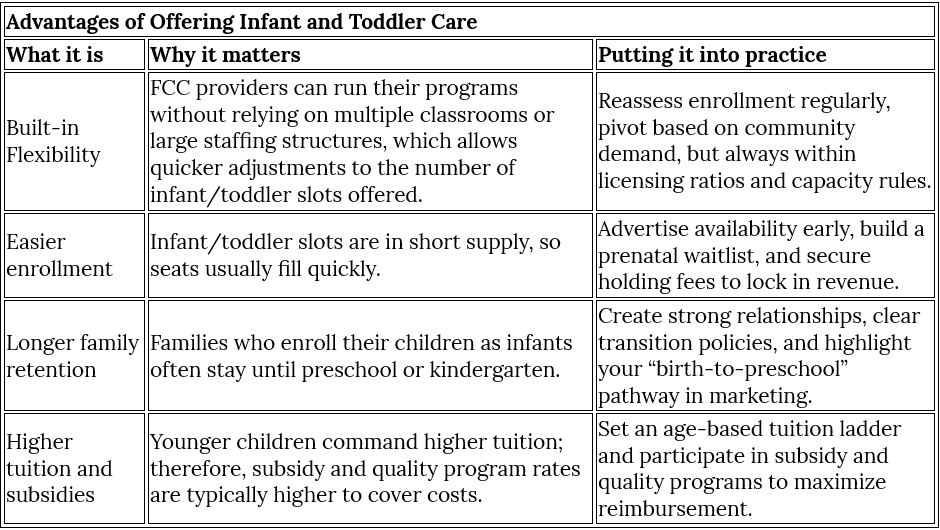
For many FCC homes, the rewards outweigh the challenges. The table below outlines key advantages, explains why they are important, and provides suggestions for actions you can take to move forward with offering infant and toddler care.
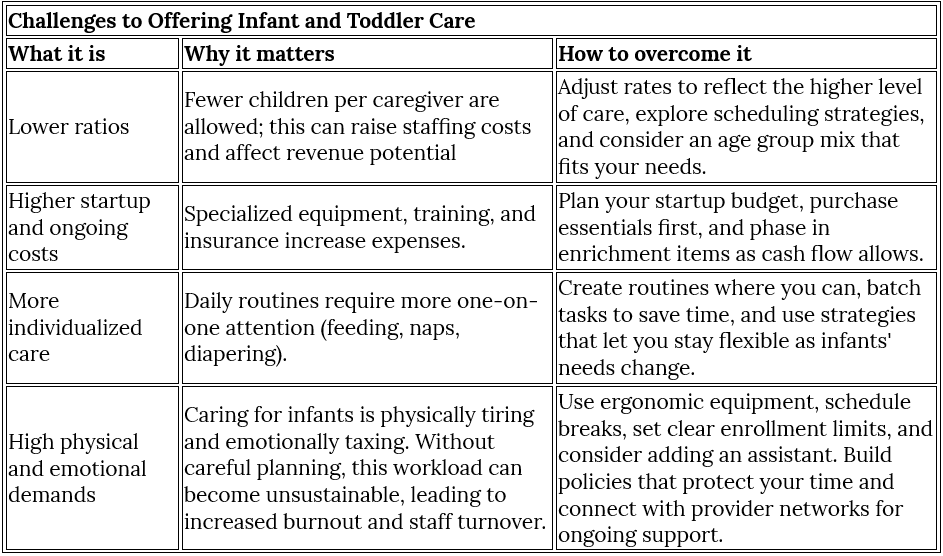
Of course, every opportunity brings its own hurdles. Infant and toddler care is no different. The table below outlines the most common challenges you may face, why they matter for your business, and practical strategies to manage them.
How does infant and toddler care change my business model?
Adding infant and toddler care affects more than your daily schedule; it also changes how you structure your business. The main areas to think about are:
Enrollment mix: How many children of each age group you serve
Pricing: How you set rates to reflect both costs and market expectations
Policies: How you adjust rules and family agreements for under-threes
Staffing: Whether to bring on an assistant or employee to meet ratio requirements and support sustainability
Cash flow: How you manage higher startup expenses alongside higher revenue
Enrollment mix
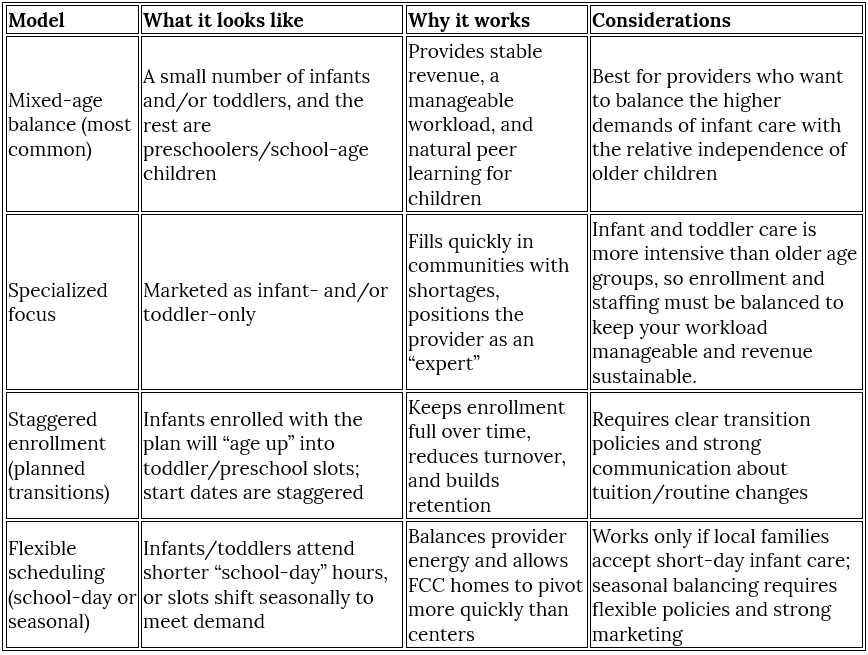
Family child care homes use different approaches to balance infant and toddler enrollment. The right model depends on your licensing capacity, your ability to manage your workload sustainably, and the needs of your local market.
Pricing
Pricing infant and toddler care requires accurately capturing both your higher costs and the realities of your local market. This is also where many providers struggle the most — not setting prices that genuinely reflect their expenses can put long-term sustainability at risk.
Costs to consider include:
Supplies - diapers, wipes, formula
Compliance requirements - crib spacing, evacuation cribs
Training and certification renewals - Safe Sleep, CPR/First Aid, Emergency Preparedness
Staffing - if you have an assistant
Additional insurance coverage - increase homeowners’ and liability insurance if needed
These expenses make infant/toddler care more costly to provide than preschool slots. At the same time, you must stay competitive within your community. Research the going rates for infant and toddler care in your area to ensure your pricing aligns with what families expect while still covering your costs.
A clear tuition ladder by age sets expectations for families and ensures you are compensated fairly for younger children. Annualized tuition billed monthly can help smooth out your cash flow and prevent revenue gaps when attendance fluctuates.
For more step-by-step support, see our guide on Setting Rates.
Policies
Clear, consistent policies are among the strongest tools you have for protecting your business. For infants and toddlers, some policies may differ from those you might set for older children.
Key considerations:
Holding fees: Because infant slots are in such high demand, consider a holding fee (credited toward the first month’s tuition) for families reserving a future start date. This locks in revenue and prevents “ghost enrollments.”
Minimum days: Under-threes need consistent care to thrive, and your business needs predictable income. Setting a minimum enrollment requirement (e.g., at least 3 days per week) reduces scheduling gaps and stabilizes cash flow.
Sick/absence policies: Infants are often home ill more frequently. Spell out that tuition is due regardless of attendance to protect your income.
Supplies: Clarify who provides diapers, wipes, formula, breast milk containers, and how everything must be labeled. This keeps your program organized and compliant.
Transitions: Outline how children move up to the next age group at 12, 24, or 36 months, including tuition changes and schedule adjustments. Doing so avoids surprises for families.
Feeding and sleep plans: Written routines signed by parents are essential. Policies should outline how you will implement these plans and how you will communicate any updates.
Communication: Daily reports are more important for infants. Set expectations about how you’ll share updates with families (written log, app, or text).
Strong policies reduce confusion, protect your time, and demonstrate to families that you run a professional business.
Staffing
Infant and toddler ratios can limit the number of children you can serve as a solo provider. To maintain income, many FCC homes choose to hire an assistant. Adding staff can expand the number of infants and toddlers you are licensed to care for, reduce the physical and emotional demands on you, and give you flexibility for breaks, professional development, or emergencies.
Considerations include:
Cost vs. revenue: Payroll is often the largest new expense. Ensure that your tuition rates and enrollment plan cover wages, payroll taxes, and any required benefits.
Management responsibilities: Hiring means learning basic HR skills — from scheduling to training and supervision. Clear job descriptions and an employee handbook with written policies are essential.
Licensing requirements: Some states have additional rules for FCC homes with staff, including training, background checks, or space modifications.
Quality and reputation: Having a well-trained assistant can improve the quality of care and reassure families that their children are safe and well attended.
Properly classifying employees: There is often a misunderstanding with business owners regarding how their employees can be classified. Classification determines whether the business must pay the employee via a W-2 form or IRS Form 1099. Individuals paid via Form 1099 are considered contractors. The laws are very strict regarding employee classification; neither the employer nor the employee decides how they will be paid. You can learn more about employee classification in this TWC resource: "When is someone a contractor or an employee?" In addition to this resource, you can find a free app here to help you determine the correct classification for your employee.
Cash Flow
Infant and toddler care typically requires a higher upfront investment than preschool care. While revenue per slot is often greater, careful planning is essential to manage the ramp-up costs and the first year of operations. Startup expenses can range from about $1,500 to $7,000, creating a barrier if funds are not budgeted in advance. These costs are also heavily front-loaded since equipment, licensing modifications, training, and insurance must be paid for before tuition payments are received. Additionally, it may take several months to fill all available slots, so providers need either cash reserves or a bridge plan to maintain stability during this period. To help sustain a positive cash flow:
Prioritize compliance first. Invest in required equipment and safety items before enrichment materials.
Phase purchases. Buy core items up front and add extras (like multiple sets of toys) once revenue stabilizes.
Track your cash flow. Monitor tuition and subsidy income against expenses monthly. A simple spreadsheet can reveal whether your infant/toddler slots are covering both day-to-day costs and long-term cash flow. The TWC "How to Keep Your Cash Flow Positive" guide can help you get started.
Plan for wear-and-tear. Infant equipment and toys can wear out more quickly, so factor this into your budget.
Marketing Strategies for Infant and Toddler Care
As you expand your enrollment to include infant and toddler care, having an effective marketing plan will be crucial for your success. You will want to appeal to families by offering the utmost in safety practices, combined with an environment specifically designed for infant and toddler care. Consider the following when evaluating your marketing strategy:
Marketing materials should:
Stress safety first. It is important for families and caregivers to have peace of mind when leaving children in your care. Include the many areas of your program that focus on safety, such as low ratios, specialized training, and safe sleep practices.
Give examples of an environment created for the age group. List accommodations specifically designed for the care of infants and toddlers, such as dedicated nap spaces, evacuation cribs, high chairs, provisions for comfort care, and layouts that allow high visibility.
Highlight that families will have the advantage of continuity of care from infancy through preschool, as well as the opportunity to take advantage of sibling discounts, if available.
Highlight premium services such as extended hours, flexible schedules, and age-appropriate curriculum.
Mention the convenience of your location in relation to major employers.
Consider reaching out to:
Current families can be excellent referral sources, but don't forget to reach out to the families of children you have cared for in the past. Their families may be growing, and they would welcome the chance to enroll their infants or toddlers in a program they can trust.
Parenting groups on social media often feature posts with families and caregivers looking for infant and toddler care.
Community faith networks, such as churches, synagogues, mosques, and other houses of worship, may have members of the congregation in need of your services.
Employer partnerships are excellent ways for local business owners to provide support for parents and caregivers returning from family leave.
As you promote your infant and toddler program, remember that families of very young children are making one of the most important decisions of their lives, and they are looking for reassurance, consistency, and care that feels personal. By combining clear communication about safety, nurturing environments, and the long-term benefits of your program with outreach through the networks where new parents are most active, you position your business as both professional and compassionate. This balanced approach will help you fill infant and toddler slots more quickly while strengthening your reputation as a reliable partner for families in your community.
How do I get started?
Contact licensing. Confirm ratio and space requirements and schedule any necessary inspections.
Build your budget. Estimate startup costs, align tuition with market demand, and explore subsidy and quality program participation requirements and reimbursement rates.
Complete any required training. Safe sleep, CPR/first aid, and infant/toddler development courses are essential.
Prepare your space. Set up designated safe sleep, feeding, and diapering areas that meet standards.
Plan for staffing. Decide whether you will operate solo or hire an assistant. If hiring, research wage expectations and licensing rules, and set aside time to create an employee handbook, recruit, and train.
Write your policies. Protect your time, finances, and family relationships by setting clear expectations.
Market intentionally. Reach out to growing families (and create a prenatal waitlist), share your daily routine, and highlight your safety practices.
Conclusion
Infant and toddler care requires more planning, investment, and energy. At the same time, it meets a major community need and offers strong revenue potential. With the right plan, you can provide valuable services to families while building a sustainable, trusted business.
Need Help?
Visit www.TexasFCCN.org for related resources, live webinar sessions, and free one-on-one business coaching.
DEVELOPED AND DESIGNED BY CIVITAS STRATEGIES
The information contained here has been prepared by Civitas Strategies® and is not intended to constitute legal, tax, or financial advice. The Civitas Strategies® team has used reasonable efforts in collecting, preparing, and providing this information, but does not guarantee its accuracy, completeness, adequacy, or currency. The publication and distribution of this information are not intended to create, and receipt does not constitute, an attorney-client or any other advisory relationship. Reproduction of this information and recording of this content (including the use of AI) are expressly prohibited. Only noncommercial uses of this work are permitted.
Copyright © 2026 Civitas Strategies, LLC®