
Start-Up Mini-Grant Initiative
Application Scoring Guidelines
Overview
The Texas Family Child Care Network (Texas FCCN) Start-Up Mini-Grant Initiative was established to assist up to 200 eligible applicants with grant funding to support them.
FCCN Providers with an active application on file with the Health and Human Services Commission (HHSC) who are looking to become registered or licensed, or to advance to a different permit level (Listed to Registered or Registered to Licensed) are eligible to apply.
Total funding available: up to $15,000 per eligible provider.
The final award amount per provider will be based on the requested amount of funding supported by documentation accuracy, programmatic need, and available funding. Scoring determines funding eligibility and prioritization, but does not automatically guarantee an award nor approval of the specific award amount requested.
Purpose
This document outlines the scoring guidelines used to establish a standardized and transparent evaluation framework to assess:
Need
Impact
Outcomes
•Financial preparedness and sustainability
The scoring framework ensures objective and consistent application review, alignment between identified needs and proposed solutions, and responsible investment of public funds.
Application Scoring Framework
Applications are evaluated across four sections with a base total of 150 points. Applicants may earn up to 30 additional bonus points for alignment with designated focus areas, for a total possible score of 180 points.
To be eligible to apply, providers must:
Be registered with the Texas Family Child Care Network, AND
Pass background checks for required personnel, AND
Have an active application to become a registered or licensed family child care provider with HHSC CCR. FCC Providers who will be eligible for the FCC Start-Up Mini-Grants will be those who are advancing from registered to licensed, listed to registered or licensed, or new FCC Providers seeking to become registered or licensed.
To be eligible for funding consideration, applicants must:
Achieve a minimum base score of 105 points (70% of 150 base points)
Meet section-level minimum thresholds
Meet mandatory coaching standards where applicable
Score Components Summary
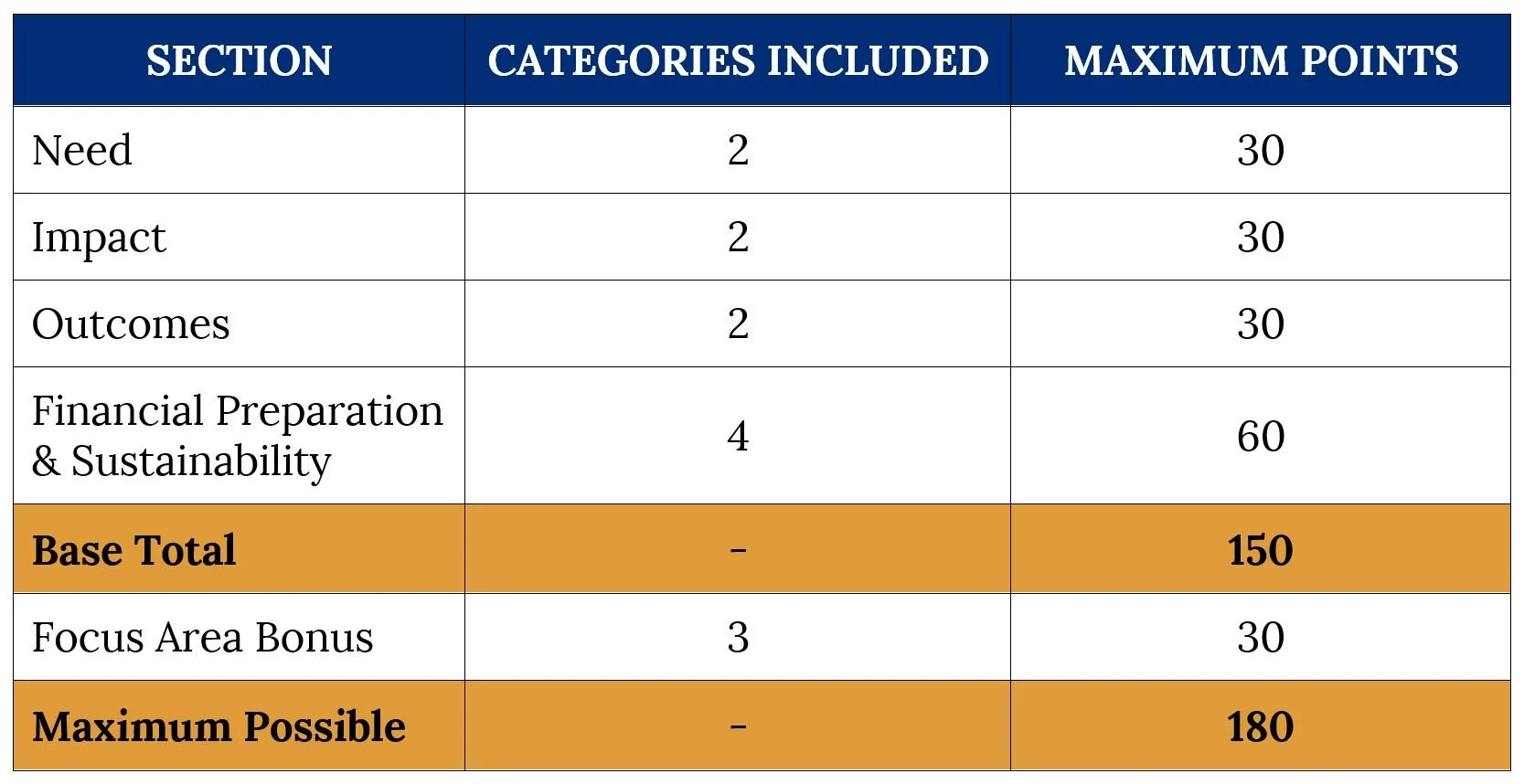
Minimum Base Score for Possible Funding: 105 Points
Base Evaluation Categories
Section 1: Need – Business Challenge (30 Points)
Evaluates clarity of the business challenge and documented community demand.
Categories:
Clarity and Specificity of Problem Statement (15 pts)
Clear Explanation of Demand, Services, and Space Needs (15 pts)
Providers must clearly describe:
The current business challenge or opportunity
Specific barriers preventing optimal performance
Demonstrated demand for services
Impact on sustainability and family satisfaction
Need Statement Example:
❌ Weak: “People in my area want more care for infants.”
✅ Strong: “Very few child care providers in my area provide care for infants and those that do have waitlists with extremely long wait times. A survey of current families showed that 60% of existing families are looking for infant care.”
Section 2: Impact – Strategic Solution (30 Points)
Evaluates operational feasibility and execution readiness.
Categories:
Critical Program Constraints Assessment (15 pts)
Timeline (15 pts)
Providers must demonstrate:
Direct connection between identified need and proposed expenditure
Identification of operational constraints and mitigation strategies
Realistic and sequenced implementation timeline
Solution Alignment Example:
❌ Weak: “I will buy toys.”
✅ Strong: “We will secure play-based learning resources that supports our approach to early childhood education. This helps to differentiate our program, supports infant/toddler enrollment growth, and strengthens our market position.”
Section 3: Outcomes – Expected Results (30 Points)
Evaluates measurable impact on operations and family engagement.
Categories:
Business Operational Efficiency (15 pts)
Family Engagement and Business Resiliency (15 pts)
Providers must demonstrate:
Measurable operational improvements (e.g., enrollment growth, revenue stability, staffing efficiency)
Clear connection between investment and improved family satisfaction or retention
Short- and long-term sustainability of improvements
Outcomes Example:
❌ Weak: “This will help my business grow.”
✅ Strong: “The additional infant classroom will increase enrollment capacity by four children, generating approximately $3,200 in monthly revenue and improving retention rates.”
Section 4: Financial Preparation & Sustainability (60 Points)
Evaluates financial competency, planning sophistication, and sustainability.
Categories:
Long-Answer Comprehensiveness (15 pts)
Rates and Rate-Setting Process (15 pts)
Budget Narrative Accuracy (15 pts)
Cash Flow Projection (15 pts)
Providers must demonstrate:
Alignment between expenses and identified need
Market-informed rate-setting methodology
Accurate and realistic budget projections
Understanding of cash flow timing and expense management
Sustainability beyond grant funding
Financial Example:
❌ Weak: “The total cost is about $14,000.”
✅ Strong: “Vendor quotes confirm total equipment costs of $13,875. Cash flow projections show increased enrollment revenue offsetting ongoing maintenance within six months.”
Budget Narrative Requirements
Each budget submission must clearly identify the specific item or service requested, the quantity needed, the unit cost, and the total projected cost. Applicants must explain how each line item directly supports the identified business need and describe the anticipated operational or financial impact. Vendor quotes or documented cost research must be attached for any service-based purchases. The total proposed budget may not exceed $15,000. All calculations must be accurate and internally consistent.
Budget Template:

Total Proposed Budget: $______ (Maximum $15,000)
Focus Area Bonus (30 Points Total)
Providers may earn up to 30 bonus points by participating or planning to participate in one or more of the following categories:
Child Care Desert (10 pts): Business located in a child care desert as defined in Texas Labor Code §302.0461(b)(2)(A)(i)
Non-Traditional Hours (10 pts): Defined as early morning care before 7:00 A.M., evening care after 7:00 P.M., overnight care, weekend care, and holiday care.
Infant/Toddler Care (10 pts): Providers offering care for children less than 36 months
Bonus points supplement the base score but do not replace minimum funding thresholds.
Minimum Funding Thresholds
To be eligible for funding:
Applicants must achieve at least 105 base points.
Applicants must achieve at least 70% of the maximum points in each section:
Section 1: Minimum 21 points
Section 2: Minimum 21 points
Section 3: Minimum 21 points
Section 4: Minimum 42 points
Applications that fail to meet a section-level minimum will trigger mandatory application coaching or be deemed ineligible based on readiness and compliance assessment.
Funding prioritization may consider focus area alignment and available funding.
Documentation Requirements
Applicants must submit complete documentation aligned to each scored section of the Application Scoring Framework. All materials must directly support the submitted funding request and demonstrate readiness to become a registered or licensed family child care home or advance to a different permit level (such as listed to registered or registered to licensed).
Applications that are incomplete, inconsistent, or unsupported by required documentation may result in reduced scoring, mandatory coaching, or application rejection.
Section 1: Need – Business Challenge Documentation
Applicants must submit:
A comprehensive Business Need Narrative (Needs, Impact, Outcomes, Financial Preparation & Sustainability) clearly describing the specific challenge or opportunity affecting the family child care business.
Evidence of parent/caregiver demand or community need, which may include waitlist data, letters of interest, documented provider shortages, or market research.
Documentation confirming space status, including secured location, pending lease agreement, expansion documentation, or status of permit application, if applicable.
Documentation demonstrating the need for services for infant/toddler care, non-traditional hours care, or child care desert care in the community, if applicable.
All documentation must clearly demonstrate the connection between the identified need and the submitted funding request.
Section 2: Impact – Strategic Solution Documentation
Applicants must submit:
A written explanation detailing how the funding request directly addresses the identified business challenge.
A description of operational constraints and mitigation strategies, including staffing, permitting, facility, financial, or enrollment considerations.
A clear implementation timeline identifying major milestones and estimated completion dates.
Documentation must demonstrate that the proposed solution is feasible, realistic, and capable of being implemented within program timeframes.
Section 3: Outcomes – Expected Results Documentation
Applicants must submit:
A description of measurable operational outcomes expected as a result of the funding request, such as projected enrollment growth, revenue stabilization, cost efficiency, or staffing improvements.
A description of anticipated impact on family engagement, retention, and long-term business resiliency.
If serving or planning to serve a priority care area (infant/toddler care, non-traditional hours care, or a child care desert community) a description of how the funding request will support high-quality care for that population.
Outcome documentation must clearly link projected results to the proposed investment.
Section 4: Financial Preparation & Sustainability Documentation
Applicants must submit:
A comprehensive and itemized budget identifying each requested item or service, quantity, unit cost, and total cost.
Vendor quotes or documented cost research supporting service-based purchases.
A written explanation of the rate-setting methodology used to determine tuition rates or service pricing.
A cash flow projection demonstrating understanding of revenue timing, expense management, and sustainability following expenditure of grant funds.
A description of how the funding request supports long-term business advancement and continued compliance with permit requirements.
The total funding request may not exceed $15,000. All calculations must be accurate and internally consistent. Budget line items must directly align with the identified business need and proposed outcomes.
Coaching Thresholds and Intervention Standards
Coaching is designed to strengthen business operations and ensure successful implementation and is offered in two ways.
Mandatory Coaching May Be Required When:
The total application scores are 52-104 points.
One or more sections fall below minimum thresholds for that section.
Material deficiencies are identified in problem definition, mitigation planning, measurable outcomes, or financial controls.
The proposed timeline presents significant implementation feasibility concerns.
Applicants requiring mandatory coaching may become eligible for funding after completing up to three 30-minute mandatory one-on-one application coaching sessions to improve their scores. Once a fundable base score of at least 105 points is achieved with minimum thresholds reached in each category, the applicant may proceed to funding consideration.
Optional Coaching May Be Available When:
The total application score falls below 52 points.
These applicants may be referred to optional business coaching tailored to their identified area of need and are encouraged to reapply once those practices are in place.
Evaluation Process
Applications will be assessed based on:
Clarity and specificity of business challenge
Strategic alignment of proposed solution
Feasibility of implementation
Budget justification and cost-effectiveness
Potential for measurable operational improvement and family engagement
Not all applications will be funded. Quality, feasibility, and sustainability are critical factors in award determination.
Final Score Calculation
Base Evaluation Score (Maximum 150 Points)
+ Focus Area Bonus (Maximum 30 Points)
= Total Possible Score (Maximum 180 Points)
Minimum Base Score Required for Funding: 105 Points (with minimum thresholds reached within each individual scoring category)
All score totals and percentage calculations must be verified for mathematical accuracy prior to final award determination.
Need Help?
Visit www.TexasFCCN.org for related resources, live webinar sessions, and free one-on-one business coaching.
DEVELOPED AND DESIGNED BY CIVITAS STRATEGIES
The information contained here has been prepared by Civitas Strategies® and is not intended to constitute legal, tax, or financial advice. The Civitas Strategies® team has used reasonable efforts in collecting, preparing, and providing this information, but does not guarantee its accuracy, completeness, adequacy, or currency. The publication and distribution of this information are not intended to create, and receipt does not constitute, an attorney-client or any other advisory relationship. Reproduction of this information and recording of this content (including the use of AI) are expressly prohibited. Only noncommercial uses of this work are permitted.
Copyright © 2025 Civitas Strategies, LLC®