
What is a Child Care Desert?
What does operating in a child care desert mean for your business?
What Is a Child Care Desert?
A child care desert is a place where there aren’t enough licensed or regulated child care spots for the number of children who need them. In other words, the demand for child care far outweighs the supply.
Why Do Child Care Deserts Exist?
Child care deserts form for many reasons, often overlapping:
In some areas, there aren’t enough family child care homes or centers.
High costs and low wages make it hard for providers to stay in business.
Public funding, training, and business resources aren’t always accessible.
Local rules can create barriers to opening new programs.
New families may move into an area faster than services can expand.
These aren’t provider problems; they’re system challenges. But understanding them can help you plan a stronger, more resilient business.
What Does This Mean for You as a Business Owner?
If you're operating in a child care desert, or considering it, you might hear a lot of assumptions about what that means. Let’s clear up a few common misconceptions:
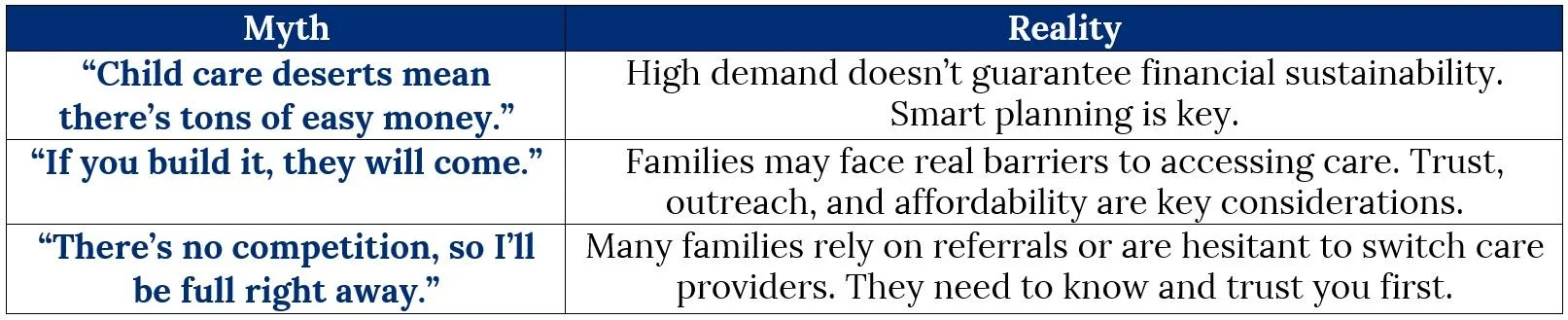
Understanding these realities can help you build a stronger business plan and avoid common frustrations. So, what are the real implications of working in a child care desert?
Operating in an underserved area presents unique opportunities, as well as a few important challenges. However, with the right approach, it’s possible not only to meet demand but also to thrive as a trusted, sustainable part of your community.
Opportunity: You’re Needed
Families in your area are likely struggling to find care. That means:
There may be a strong, steady demand.
You may be filling a critical gap in your community.
You can build long-term relationships and establish yourself as a trusted voice.
Challenge: Affordability Doesn’t Always Match Demand
Even when care is urgently needed, not every family can afford to pay enough for your business to thrive. It helps to understand:
Income levels in your community.
Whether subsidies or public programs are available.
Creative ways to make your business model work, like part-time spots, sliding scale rates, or partnerships with employers.
Opportunity: Less Competition
Fewer providers can mean:
Families may be more likely to stay with you long-term.
Word-of-mouth marketing may spread more quickly.
You can tailor your program to meet the unique needs of your community, such as evening care or bilingual instruction.
Challenge: Limited Local Support
You might not have many nearby peers, staff candidates, or business resources. But you’re not alone. Many providers in similar situations have found support by:
Joining statewide or regional child care associations.
Building relationships with nearby schools, churches, or nonprofits.
Connecting with business coaches or peer networks online.
Quick Check: Do You Know Your Local Market?
Understanding your market enables you to make informed business decisions. Ask yourself:
Are there employers nearby working with parents and caregivers?
What are their hours? Do families need evening, weekend, or drop-in care?
What age group is hardest to place: Infants? Toddlers? Preschoolers?
What do families say they wish they could find in a provider?
Are there barriers, such as transportation or cost, that prevent families from enrolling?
These answers are your starting point for designing a business that truly meets your community’s needs.
What Should You Do Next?
Thriving in a child care desert starts with understanding the landscape—and then building a business that meets the needs of both your community and your bottom line.
Here’s how to move forward:
Step 1: Evaluate Your Local Market
Use the "Quick Check" questions above to gather insights on your area. Talk to families. Reach out to employers. The more you understand your community, the more effective your business decisions will be.
Step 2: Clarify Your Business Model
Ask yourself:
1. What age groups and hours of care will I offer?
2. How will I price my services to make them accessible while still covering my costs?
3. What makes my program unique or essential in this community?
This clarity will help you plan for sustainability, not just survival.
Step 3: Identify Partnerships and Resources
You don’t have to go it alone. Consider:
1. Local schools, nonprofits, and businesses that might refer families.
2. Regional or statewide child care networks or associations.
3. Business coaching programs, especially those focused on family child care.
Building your support network is just as crucial as building enrollment.
Step 4: Start Small, Plan Smart
Even small changes, such as adjusting your schedule to meet family needs or introducing a sliding scale, can enhance your reach and stability. Focus on progress, not perfection.
Need Help?
Visit www.TexasFCCN.org for related resources, live webinar sessions, and free one-on-one business coaching.
DEVELOPED AND DESIGNED BY CIVITAS STRATEGIES
The information contained here has been prepared by Civitas Strategies® and is not intended to constitute legal, tax, or financial advice. The Civitas Strategies® team has used reasonable efforts in collecting, preparing, and providing this information, but does not guarantee its accuracy, completeness, adequacy, or currency. The publication and distribution of this information are not intended to create, and receipt does not constitute, an attorney-client or any other advisory relationship. Reproduction of this information and recording of this content (including the use of AI) are expressly prohibited. Only noncommercial uses of this work are permitted.
Copyright © 2026 Civitas Strategies, LLC®