
Start-Up Mini-Grant Initiative
Application Guide
A Step-by-Step Guide to Understanding Texas Family Child Care Network Start-Up Mini-Grant Requirements and How to Apply
The information on this page is applicable only to those who applied for the mini-grant in April 2026.
Please go to the current Mini-Grant Initiative website for those applying for the October 2026 deadline.
Introduction
Texas Family Child Care Network (Texas FCCN) Start-Up Mini-Grant Initiative is funded by the Texas Workforce Commission (TWC) to support Texas FCCN members who are advancing their child care home permit type or new family child care providers seeking to become registered or licensed. These funds help offset costs related to opening or advancing their family child care home.
Texas FCCN Start-Up Mini-Grants are available for up to 200 eligible recipients. Each recipient can receive up to $15,000 disbursed via direct deposit.
Eligibility
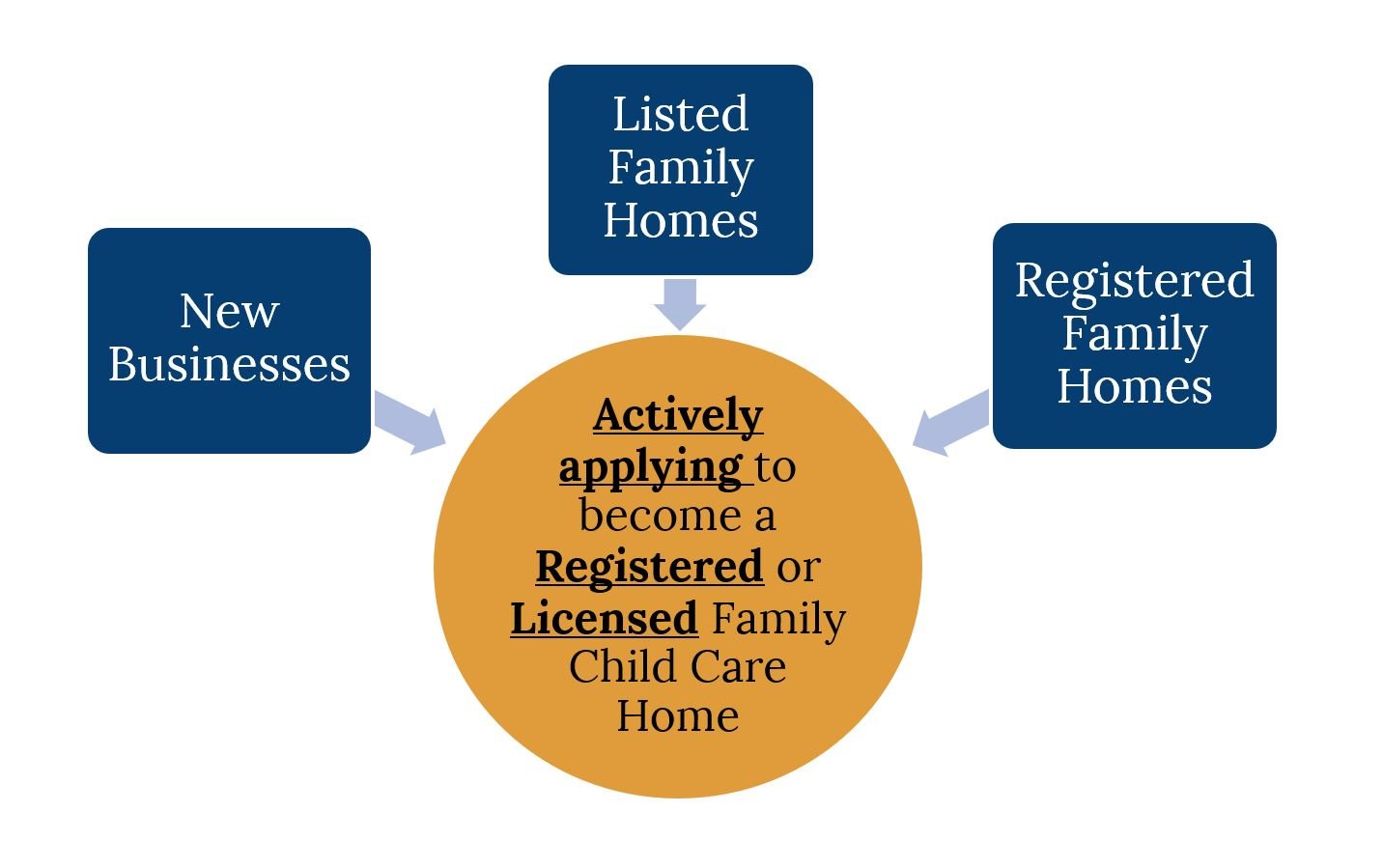
This competitive opportunity is available for providers with an active application with the Health and Human Services Commission's (HHSC) Child Care Regulation (CCR) to become a registered or licensed family child care home. FCC Providers who will be eligible for the Texas FCCN Start-Up Mini-Grants will be those who are advancing from registered to licensed, listed to registered or licensed, or new FCC Providers seeking to become registered or licensed. Applicants must be members of the Texas Family Child Care Network and pass required background checks for permitting to be considered for funding.
Offering Infant or Toddler Care
Eligible providers offering or planning to offer care for infants or toddlers younger than 36 months of age will receive bonus points on their application. Applicants must demonstrate a plan and ability to serve infants and toddlers within required child/caregiver ratios, supported by a DocuSign attestation and CCR permit application and inspection information.
Child Care Desert
Applicants who are applying to become a registered or licensed family child care home within a child care desert will receive bonus points on their application.
A child care desert is defined in Texas Labor Code §302.0461(b)(2)(A)(i) as an area where the number of children younger than six years of age with working parents is at least three times greater than the capacity of licensed child care providers in the area.
An applicant's location zip code determines child care desert status. The child care home must be physically located within a designated child care desert zip code. Applicants will attest via DocuSign that they are operating or will be operating in a child care desert.
Non-Traditional Hours
Applicants operating or planning to operate during non-traditional hours will receive bonus points on their application. Non-traditional hours' care is defined as early morning care before 7:00 A.M., evening care after 7:00 P.M., overnight care, weekend care, and holiday care.
To qualify, applicants must demonstrate they currently offer or will offer care during non-traditional hours. Applicants must attest via DocuSign to the specific hours of care. Applicants must certify that the attested hours are the official operating hours for the location listed in their application.
Note: Providers who offer these services may be eligible for additional application points. You do not need to provide services within these three focus categories to apply.
What Funding is Available?
Recipients may receive up to $15,000 per provider. Your specific award amount will be determined based on your funding request supported by demonstrated need, proposed budget, and the strength of your financial planning.
Allowable Use of Award Funds
Allowable costs under the mini-grants are those related to health, safety, and child learning, which include:
Indoor furnishings and supplies;
Outdoor learning materials;
Instructional materials;
Child safety items;
Personal protective equipment, cleaning, and sanitization supplies;
General liability insurance;
Minor repairs and building modifications necessary to ready the dedicated indoor and outdoor learning areas, including fencing, only if and to the extent required for licensing, and excluding construction or major renovation;
Kitchen and household safety materials or supplies, including fire extinguishers, smoke detectors, and carbon monoxide detectors;
Permitting fees, for example, for CCR or as related to inspections; and
Outreach costs associated with recruitment of families and staff.
Reimbursements are only allowable upon request for HHSC CCR application fees and/or required background checks. Reimbursements must include a payment receipt for each paid amount dated within three (3) months prior to the reimbursement request. Please know that reimbursement requests may require an amendment to your award agreement and that your total funding cannot exceed $15,000.
Unallowable Uses of Award Funds
Funding from a mini-grant must NOT be used for the following items:
Down payments, security deposits, and other one-time payments associated with securing a location to provide child care;
Construction of new facilities;
Payments for providers and staff
Major Renovations to existing facilities;
Vehicles; and
Equipment.
Major renovation is defined as:
(1) structural changes to the foundation, roof, floor, exterior, or load-bearing walls of a facility, or the extension of a facility to increase its floor area; or
(2) extensive alteration of a facility such as to significantly change its function and purpose, even if such renovation does not include any structural change.
Equipment is defined as physical items that:
Last more than 1 year
Cost $5,000 or more per item, including acquisition cost
Acquisition cost means the total cost to buy the item and get it ready to use. This includes:
The purchase price
Any needed modifications or accessories
Installation or setup
For more details about allowable and unallowable costs, visit our spending guide here.
How Can I Apply?
Visit the Texas FCCN website to view or print your application. We recommend saving a copy to help you prepare your responses in advance.
Your application will include key information about your child care business and your plan to become a registered or licensed family child care home.
Step 1: Complete Your Written Application
If you have an active application to become a registered or licensed family child care home, you've already got a plan in mind. As part of the application process, you'll document this plan through three long-answer questions and detailed business planning components.
Begin by reviewing the application questions available on the Texas FCCN website. Prepare your responses offline before submitting.
Application Long-Answer Questions
Your application includes three long-answer questions that help evaluators understand your need for the grant, your plan to address that need, and the expected outcomes.
Section 1: NEED (30 points)
What challenge are you facing? Describe the main challenge or barrier preventing your child care business from succeeding. What evidence do you have that this challenge is significantly limiting your program?
Section 2: IMPACT (30 points)
How will you address it? What is your plan to solve this challenge, and how will your proposed solution directly address the limitations you’re facing?
Timeline: Provide a detailed timeline showing the most important steps you'll take to obtain your new child care permit. This should include specific dates for key milestones. You'll submit your timeline using the timeline template.
Section 3: OUTCOMES (30 points)
What will be the result? Describe the long-term benefits of your proposed solution. How will this improve your operations, impact the families you serve, and support your business sustainability?
Section 4: Financial Planning Details (60 points)
The financial planning section requires detailed information about how you plan to financially support your business. This will include:
Rates: Decide on your rates and explain how you determined these amounts. This helps us determine if your rates will cover your costs and how they compare to other rates in your area.
Budget Narrative: Your application must include a budget for the six-month spending window of awarded funds, using the budget narrative template. This helps us confirm that you're aware of the expenses you expect to encounter during your first year of operations. Your budget should focus on expenses that directly support your efforts to achieve licensure or registration. Funds must be spent within six months after your award agreement is granted. Use exact dollar amounts when possible and keep your goals realistic.
Ensure your budget narrative include show you plan to fund the changes you'll make to become a registered or licensed child care provider. This funding can come from your own funds, business loans, or other sources. Information about your liability insurance coverage is also required.
Your award can cover expenses such as indoor and outdoor furnishings, safety supplies, educational materials, permit fees, outreach costs, and minor renovations. However, funds cannot be used for down payments or security deposits, rent or mortgage payments, construction or major renovations, vehicles, equipment, or expenses covered by other funding sources.Cash Flow Forecast: Submit a projected cash flow statement using the provided guide and template. This helps us confirm you're able to manage your cash flow by saving during high-income months to offset low-income months.
Section 5. Bonus Focus Area Points
Applications addressing priority focus areas can earn up to 30 bonus points (10 points each). All applicants will be required to attest to providing care within priority focus areas:
Infant/Toddler Programs: Serving children younger than 36 months
Desert Area Care Programs: Operating in designated child care deserts
Non-Traditional Hour Care: Providing care defined as early morning care before 7:00 A.M., evening care after 7:00 P.M., overnight care, weekend care, and holiday care.
Minimum Funding Consideration: 105 Points (70% of 150 total points)
Applications must achieve at least 105 points to be considered for funding. Meeting this minimum does not guarantee funding, as final selections are based on overall program priorities and available budget.
To be eligible for funding:
Applicants must achieve at least 105 base points.
Applicants must achieve at least 70% of the maximum points in each section:
Section 1:Minimum 21 points
Section 2: Minimum 21 points
Section 3:Minimum 21 points
Section 4: Minimum 42 points
For more detailed information on completing your application, please see the Application Scoring Guidelines guide, which will help you frame your responses.
Step 2: Gather Your Documentation
In addition to your application materials, you'll also need to provide some documentation to help the review team confirm your eligibility to apply and verify your information. To streamline your application, gather this information in advance:
Documents that would prove your address location include a utility bill, rental agreement, property deed, or mortgage bill
Proof of an active HHSC CCR Application for Registration or Licensure: Copy of your application acceptance letter from Child Care Regulation.
Background check verification for all required household members (age 14 and older)
Most recent Tax Returns (Two returns must be submitted): Business tax returns (or personal tax returns if you do not have business tax returns) from years 2023-2025
A detailed budget list showing the items you are requesting and estimated costs (Template available)
A detailed timeline outlining the steps you expect to take to obtain your child care permit (Template available)
Receipts for application fees and required background checks – these are reimbursable within three months of payment if you provide documentation to support your request.
Any additional documentation requested to confirm eligibility or permitting progress
Step 3: Submit Your Application Materials
Gather the following supporting documents to strengthen your application:
General business contact information
Long-answer responses to the three application questions, timeline, and financial planning documents (see Step 1)
Required documentation (see Step 2)
For priority focus areas: If your family child care home is located within a child care desert, offering infant and toddler care, and/or non-traditional hours, you will be asked to sign an attestation form specifying your services as part of the application review process.
Before submission, carefully review your entire application to ensure all sections are complete, clear, well-researched, and your budget is appropriate. A polished, thorough application reflects your professionalism and attention to detail. You will not be able to edit your application after it is submitted, but revisions may be assigned during application coaching.
Step 4: Complete Application Coaching (if needed)
Two types of coaching are available:
Mandatory Coaching: If your application scores below specific thresholds in key business areas, you will be required to participate in application coaching before final evaluation. Mandatory coaching is designed to support, not penalize, by providing targeted assistance to improve your business operations. Applicants can participate in up to three 30-minute one-on-one coaching sessions with a business coach, with a focus on areas of need identified in the initial scoring of your application.
Important: Coaching is provided at no cost to you. Participating in coaching does not guarantee funding approval, but failure to participate in mandatory coaching when required will result in application disqualification.
Optional Business Coaching Referral: In some cases, applicants with notably low scores will be declined for funding and referred to business coaching. In these instances, low scores indicate that key business practices must be put into place prior to consideration for funding. Applicants in this category will be referred based on their area of need. These applicants may also reapply for funding.
Understanding the Award Approval Process
After submitting your application, it will be evaluated based on eligibility requirements and the strength of your proposal using a scoring system with a base total of 150 points, and the opportunity to earn up to 30 bonus points:
NEED (30 Points)
IMPACT (30 Points)
OUTCOMES (30 Points)
FINANCIAL PREPARATION & SUSTAINABILITY (60 Points)
BONUS FOCUS AREA POINTS (30 Points)
Minimum Score: Applications must achieve at least 105 points (70% of the total 150 points) to be considered for funding.
Up to 200 applicants will receive funding, or until available funds are exhausted.
Applications that do not achieve a fundable score, or that remain pending when funds are exhausted, will be notified by email that their application has been declined.
Disqualification Criteria
Applications may be disqualified for:
Incomplete applications
Funds used for non-approved purposes
Missed reporting deadlines
Failure to participate in mandatory coaching
Low-scoring application materials
Noncompliance or fraudulent submissions
Step 5: Award Agreement
If your application is approved, you'll receive an email notification with information on reviewing and signing the award agreement outlining specific terms and conditions. This agreement will specify:
The timeline for spending funds within six months of agreement execution
Your commitment to participating in CCS once licensed or registered
Requirements for maintaining proper financial records
Reporting and monitoring requirements for how funds are used
Conditions under which funds might need to be returned
Take time to review this agreement carefully before signing, as it constitutes a binding commitment to use the funds as specified.
You will also receive information about submitting required reporting and monitoring documentation in case you wish to complete this obligation as soon as you finish spending your funds. You can learn more about reporting and monitoring in our guide.
Managing Your Texas Family Child Care Start-Up Mini-Grant Award
Payment Distribution
After your award agreement is signed, your one-time disbursement of allotted funds will be processed via direct deposit. Funding recipients will receive onboarding information from Gusto, the Texas FCCN payment system. Funding recipients will be able to enter their payment details into the system directly, after which payments will be sent by direct deposit.
Awards will be disbursed shortly after completion of DocuSign agreements and Gusto setup. Applicants will have six months to spend their award and will then be required to submit reporting and documentation of their spending on allowable costs.
Compliance Requirements
You'll need to comply with several important requirements as part of receiving funding:
Use funding only for allowable expenses
Retain documentation of all spending for at least 3 years
Comply with monitoring and reporting requirements within 15 calendar days upon request, including your Final Report using the provided templates
Notify Civitas Strategies within 10 calendar days if any situation arises that would impact your eligibility
Return any unused funds at the end of the funding period
Important: You must spend all funds within six months after signing your agreement. If you do not submit requested documentation within 15 calendar days of the initial request, your award may be flagged for noncompliance.
Read the guides Texas FCCN Start-Up Mini-Grant Reporting and Monitoring Guide and the Texas Family Child Care Network Start-Up Mini-Grant Initiative Spending Guide to learn more about documentation requirements and monitoring processes. Failure to comply with terms and conditions may result in recoupment of funds and prevention of participation in future TWC-funded initiatives.
Best Practices for Recordkeeping
If you're awarded a Texas Family Child Care Start-Up Mini-Grant, start good recordkeeping habits right away. Create a folder, either paper or digital, just for grant-related documents. Place all receipts in this folder as soon as you make purchases with grant funds. You should be keeping all grant-related documentation for at least 3 years. This will help ensure you're able to participate in all required reporting and monitoring processes quickly and easily.
Need Help?
Visit www.TexasFCCN.org for related resources, live webinar sessions, and free one-on-one business coaching.
If you have questions or need assistance with your child care business, reach out to minigrant.texasfccn@civstrat.com.
DEVELOPED AND DESIGNED BY CIVITAS STRATEGIES
The information contained here has been prepared by Civitas Strategies® and is not intended to constitute legal, tax, or financial advice. The Civitas Strategies® team has used reasonable efforts in collecting, preparing, and providing this information, but does not guarantee its accuracy, completeness, adequacy, or currency. The publication and distribution of this information are not intended to create, and receipt does not constitute, an attorney-client or any other advisory relationship. Reproduction of this information and recording of this content (including the use of AI) are expressly prohibited. Only noncommercial uses of this work are permitted.
Copyright © 2026 Civitas Strategies, LLC®